
 Available in US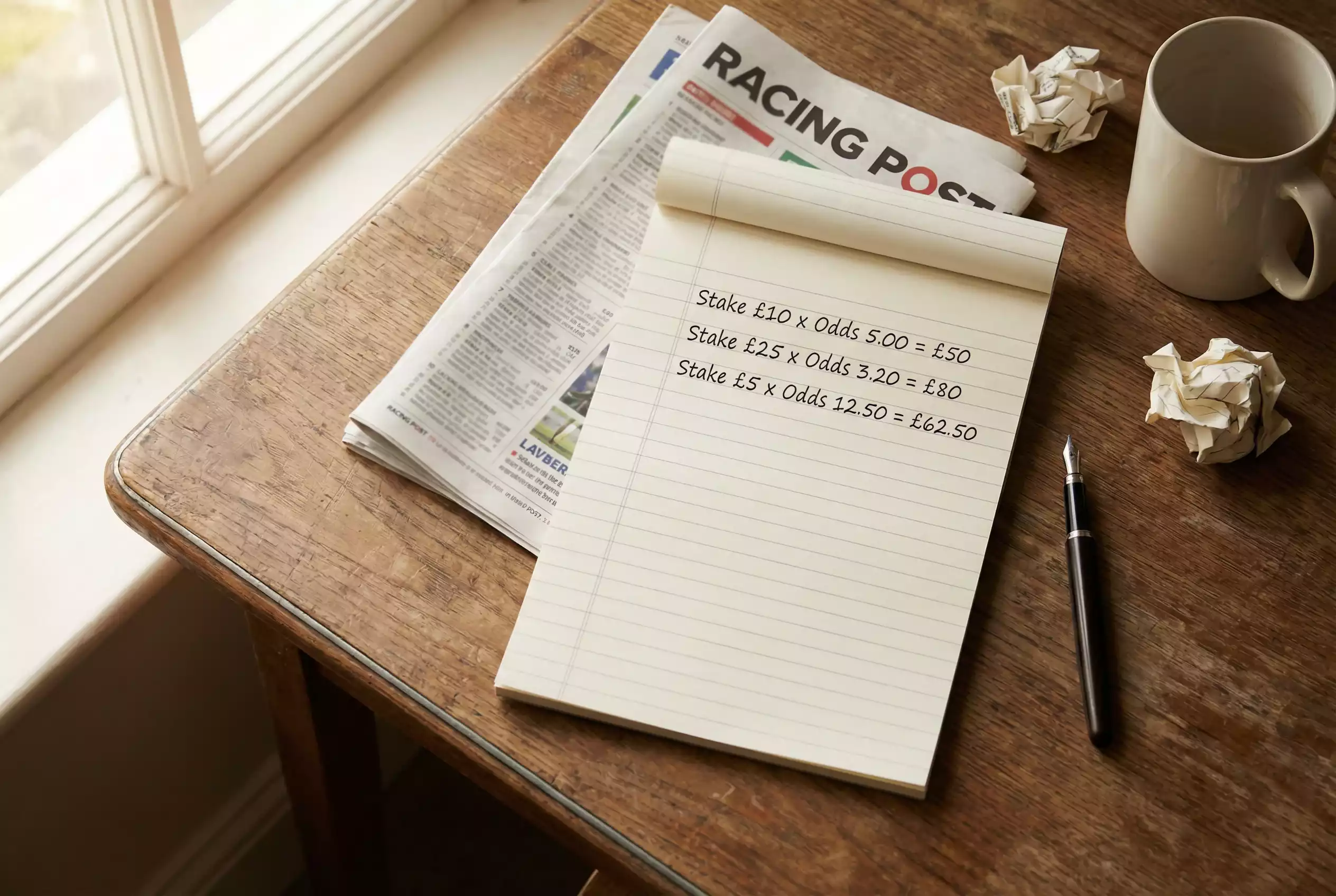
Introduction
Knowing your potential return before placing a bet transforms gambling from guesswork into informed decision-making. While betting apps calculate returns automatically, understanding the underlying mathematics helps you assess value, compare options, and avoid errors when the numbers matter most.
Research from OLBG and YouGov found that forty-three percent of people planning to bet on the Grand National intended to stake less than ten pounds. For these modest wagers, return calculations might seem unnecessary. Yet Entain data shows that roughly fifty percent of Grand National turnover comes from bets of five pounds or less, meaning millions of small-stakes punters collectively benefit from understanding how their potential winnings are determined.
The calculations differ depending on bet type. Single bets follow straightforward multiplication. Each-way bets split into two components requiring separate calculation. Multiple bets compound through a rolling process. Mastering each formula ensures you always know what you stand to win before committing your stake.
Calculating Betting Returns — More on this topic at horse racing bets explained.
Single Bet Returns
Single bet returns in fractional odds follow a two-part formula. First, calculate profit by multiplying your stake by the odds fraction. Then add your original stake to find total returns. At 5/1, a £10 stake generates £50 profit, plus the £10 stake returns, totalling £60.
When odds don’t divide cleanly, the calculation requires more care. At 11/4, multiply your stake by 11, then divide by 4. A £20 stake times 11 equals £220, divided by 4 gives £55 profit. Add the £20 stake for £75 total returns.
Decimal odds simplify the process to a single multiplication. Your stake times the decimal odds equals total returns directly. At 3.75 decimal, a £20 stake returns £75. No separate profit calculation needed, no addition step. The decimal already includes the stake portion.
Odds-on bets confuse some punters because profit is smaller than stake. At 4/5, multiply your stake by 4, then divide by 5. A £25 stake times 4 equals £100, divided by 5 gives £20 profit. Add the stake for £45 total returns. You risked more than you won, which reflects the selection’s status as favourite.
Evens, written as 1/1 or 2.0 decimal, produces profit exactly matching your stake. A £15 bet at evens returns £30, comprising £15 profit and £15 stake. This midpoint divides odds-against from odds-on territory.
Checking your calculations before confirming a bet catches errors that might otherwise go unnoticed until settlement. Betting slips display potential returns, but glancing at that figure knowing how it was derived builds confidence that you’re getting what you expect.
Mental shortcuts develop with practice. Doubles at evens return four times the stake. Trebles at 2/1 return twenty-seven times. These reference points help estimate whether displayed returns on an app seem roughly right without requiring full calculation each time.
Each-Way Returns
Each-way bets comprise two separate wagers: a win bet and a place bet. Your stated stake applies to each portion individually, so a £5 each-way bet actually costs £10 total. Calculating returns requires working through both parts and combining the results.
The win portion follows standard single bet calculation. If your horse wins at 8/1 with a £5 win stake, profit equals £40 plus the £5 stake for £45 returns from the win part alone.
The place portion uses reduced odds based on the race’s place terms. Standard terms pay a fraction of the win odds, typically one quarter or one fifth depending on field size and race type. At 8/1 with quarter odds, the place odds become 2/1. Your £5 place stake at 2/1 returns £10 profit plus £5 stake for £15.
When your horse wins, both portions pay out. Using the example above: £45 from the win bet plus £15 from the place bet equals £60 total returns from a £10 total stake.
When your horse places but doesn’t win, only the place portion pays. The win stake is lost. Using the same example with a second-place finish: £15 returns from the place bet minus the £5 lost win stake leaves £10 profit on your £10 total outlay.
Extended place terms at festivals change the calculations. Cheltenham races often pay four places instead of three, sometimes at improved fractions like one quarter instead of one fifth. These enhanced terms increase place portion returns, making each-way betting more attractive on competitive handicaps.
Step-by-step, a complete each-way calculation looks like this. Horse priced at 10/1, each-way stake £6, race paying three places at one fifth odds. Win portion if successful: £6 times 10 equals £60 profit plus £6 stake totals £66. Place portion using 2/1 odds: £6 times 2 equals £12 profit plus £6 stake totals £18. Combined returns if the horse wins: £66 plus £18 equals £84 from £12 total stake.
Dead heats reduce place portions proportionally. If two horses tie for second in a race paying three places, your place returns are halved. The full calculation requires applying the dead heat reduction before adding stake. This complication arises occasionally in large-field handicaps where photo finishes determine minor placings.
Multiple Bet Returns
Multiple bets roll winnings from one selection onto the next. Calculating returns requires working through each leg sequentially, using the output from one stage as the input for the next.
For a double at 3/1 and 5/2 with a £4 stake, start with the first selection. Four pounds at 3/1 returns £16. That £16 becomes the stake on the second selection at 5/2. Sixteen pounds at 5/2 returns £56. The double pays £56 total if both win.
Using decimal odds streamlines the process. Convert 3/1 to 4.0 and 5/2 to 3.5. Multiply them together: 4.0 times 3.5 equals 14.0. Your £4 stake times 14.0 equals £56. Same answer, fewer steps. For larger multiples, decimal multiplication remains more manageable than sequential fractional calculation.
Trebles extend the pattern. Add a third selection at 2/1 (decimal 3.0). Multiply all three: 4.0 times 3.5 times 3.0 equals 42.0. Your £4 stake returns £168 if all three selections win. Each additional leg multiplies into the running total.
Accumulators of four, five, or more selections follow identical logic. The combined decimal odds become astronomically high for longer accas, which explains both their appeal and their difficulty. A five-fold where each selection averages 3.0 produces combined odds of 243.0. A £2 stake would return £486, but landing five consecutive winners remains statistically challenging.
Non-runners reduce multiples without voiding them entirely. A withdrawn horse is treated as a winner at 1.0 decimal, effectively removing that leg from calculations. Your four-fold becomes a treble, with reduced potential returns but a surviving bet.
Rule 4 deductions for late withdrawals complicate settlement on winning multiples. Each affected leg has its returns reduced according to the deduction scale, and those reduced amounts then roll onto subsequent legs. The final return can differ significantly from pre-deduction expectations.
Online calculators handle complex multiples instantly, but understanding the underlying process helps verify those results and catch any discrepancies. When potential returns on a significant bet seem surprising, working through the calculation manually confirms whether the displayed figure is correct or whether something has been miscalculated.
Cover bets like Trixies and Yankees involve multiple separate calculations. Each component, whether a single, double, treble, or accumulator, is calculated independently and then summed. A winning Trixie requires adding returns from up to three doubles and one treble, each calculated using the relevant selections’ odds.
See also Overround Explained.
